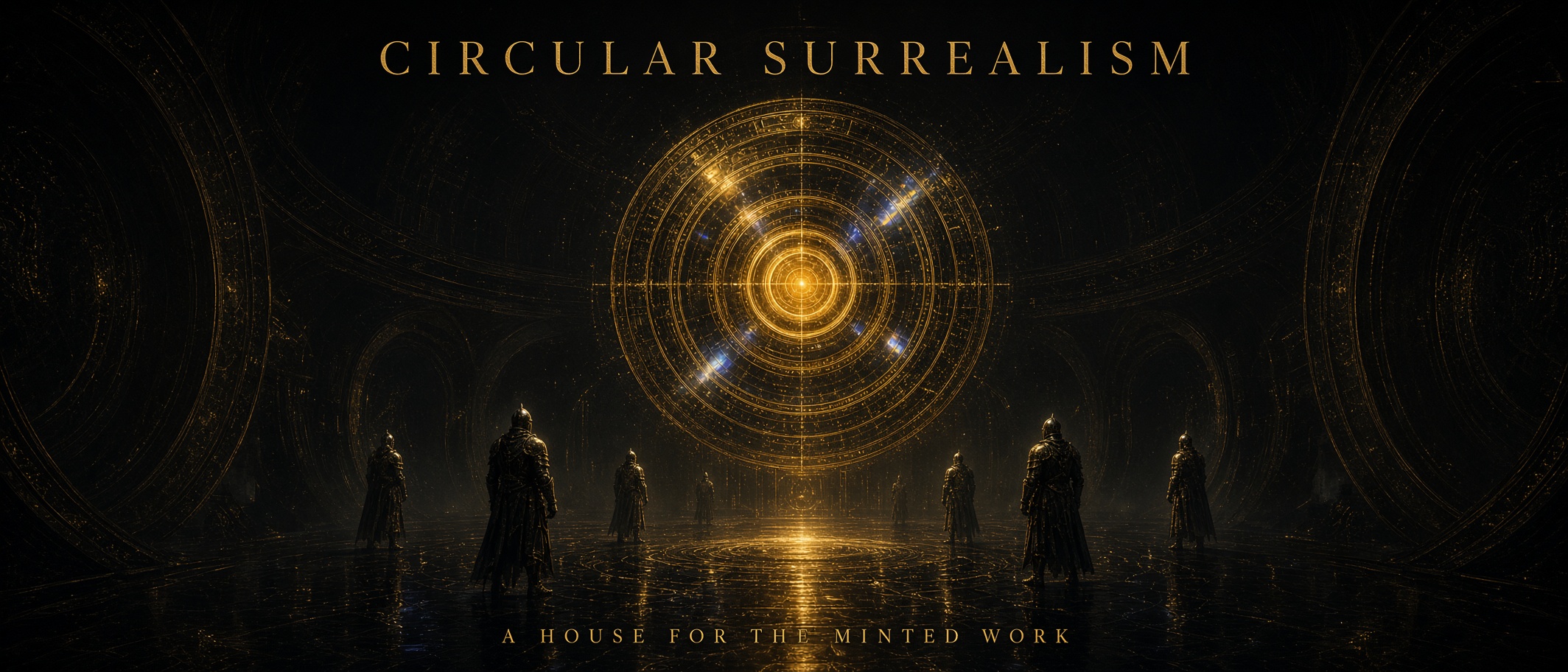
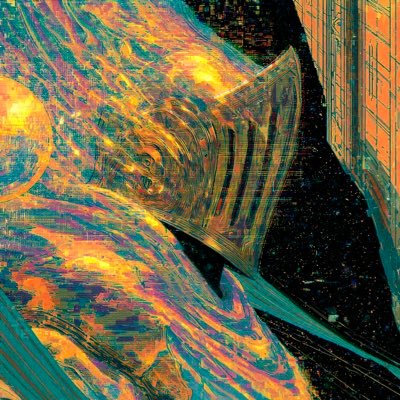
This is not a tutorial from a company. These are notes from building circularsurrealism.com with Grok Build: four chains, more than four hundred works, twenty-seven collections, rooms that open on a phone, a ledger that listens to the chain, a hang that knows what you hold, Look that can survive a 6K still, socials that update themselves, a domain I already owned, a backup of the files, and a long stretch of work until the house actually held the work — then another stretch to make it light, then another to make it a museum and not a brochure.
I am Slowfreeze. I have been an artist working with AI since 2022. Circular Surrealism is not a filter I put on an image. It is the world the work comes from — orbs, circles, knights, myth, identity, the infinite.
For years that work lived only on marketplaces: Transient Labs, Foundation, SuperRare, OpenSea, Objkt, Rodeo, Zora, Manifold, Networked.art, Mallow. Links. Tabs. A collector had to already know my name to find the whole of it.
I wanted a house. A museum for everything I have minted — Ethereum, Base, Tezos, Solana — in the language of Circular Surrealism. Not a living website as a slogan. A place the work can live.
Not a Linktree. Not a grid that dies when you add video. One place that knows the pieces, the chains, the listings, the sales, the years, the language — and that I could keep changing by talking, looking, and sending a screenshot until it was right.
I am writing this for artists. Not only AI artists. Painters, photographers, sculptors, musicians, anyone with a body of work scattered across platforms who wants one place that is actually theirs. You do not need to become a developer. You do need to know your work. You do need to sit with the preview until it is true.
That tool was Grok Build.
I am also going to be honest about the quality, because being modest here would hide the point. I look at a lot of artist websites in web3. Most of them are a nicer Linktree, or a marketplace profile pretending to be a museum, or a grid that cannot hold video. I have not seen one that puts this much of the work — and the machinery around it — in one place: four chains, hundreds of pieces, live listings, a sales ledger, collect buttons that go to the real market, a hang that names you when you connect, Look that is a real zoom into the still, the years, a salon, a wall, process, exhibitions, marks, activity, and still opens on a phone. That did not happen in an afternoon. That is why I am writing the whole path down. If you want a house like this, you should know what the work actually is.
What Grok Build is
Grok Build is not “make me a website” and walk away.
You stay in one conversation. You talk. It builds. You get a live preview in the same chat. You say what is wrong. It changes the house. When a chapter is true, you publish, and the live URL updates.
You do not need a terminal. You do not need to know what a framework is. You need to know your work — and to refuse “close enough.” This edge is wrong. This room does not belong on the homepage. This video has to play on the phone, not only after someone opens OpenSea.
If you treat it like a vending machine, you get a vending-machine site. If you stay with it the way you stay with a piece until it is finished, you get a house.
One site, one conversation
This matters more than any feature.
Circular Surrealism was built in one long thread. Every room, every wallet, every caption, every “no, switch those two titles” sits on top of what was already true.
If you want a second, completely different website, you open a new conversation. You do not mix two houses in the same chat. I asked this out loud before I even considered it. I would not risk the museum for a side experiment.
Stay in the thread. Publish. Keep talking. The next edit stacks. The on-chain connections you already set do not vanish because you changed a sentence on About.
Start from the work, not from a template
We did not start with “artist portfolio, dark mode, three pages.”
We started from what already existed:
- The published site, when we still had it
- The catalog: every piece, every collection, every contract
- The wallets: Ethereum / Base, Tezos, Solana
- The marketplaces where the work actually lives
- The language: Circular Surrealism, the knights, the orbs, the seal
- The process: Midjourney, Lightroom Super Resolution, Procreate, then motion when the still can hold more
Give Grok Build the real things. Wallet addresses. Collection links. Transient Labs. Objkt. Rodeo. The ENS. The email. The pinned Instagram of the one physical exhibition. Screenshots with arrows when a caption is on the wrong photograph.
It cannot invent your provenance. It can hang it.
My catalog in the house is, as of this writing, more than four hundred works across twenty-seven collections on Ethereum, Base, Tezos, and Solana. Mystic Knights from 2022. Genesis. The 111-piece expansion. Landscapes. Geometric Minimalism. SOLES. III III III. Ethereal Glitch. Present Visions. Unmasked Knights. Based Knights and the sixteen animations. Mystic Orbs and their animations. Rodeo. Zora. The Tezos gallery. The NYC editions born from Art Den. That inventory is the spine. Every room hangs from it.
If you are going to do this: make the inventory first. Names, numbers, chains, links to collect. A beautiful empty museum is still empty.
How I actually talk to it
I do not write tickets.
I say: the wall is too heavy for the homepage — leave the phrasing and the door, put the mosaic in its own room so the site does not crash. I say: Available should only be what is listed right now, with the real collect button. I say: Mystic Orbs, not Orbs, because someone else already used that name. I say: put marketplaces above socials in the footer. I send a screenshot with a red double arrow and say switch these two titles.
Specific. Visual. Final.
The simple jobs are how you start. The house only became a house when the jobs got harder. I did not say “make a gallery.” I said: tie the catalog to the wallets and the contracts on Ethereum, Base, Tezos, and Solana. Listen to Transient Labs, Manifold, OpenSea, Networked.art, Objkt, Rodeo, Zora. If a piece is listed, mark it live on every card. If an auction is actually bidding, show the offer and the countdown. If the lot has not started, say listed — not auction. Do not make me type that Mystic Orb #47 sold.
I said: Reach should read the public profiles — X, Instagram, TikTok, Farcaster, Threads, Facebook — and never print a fake zero when a network hides the number. The house should count its own visits. I said: the hero has seventy-two works, always a still first so the door is never blank, then a different piece each time you open it. I said: cards cannot play 4K. Cut light loops for the cards. Keep 4K for the hero and for when you open the piece. My Reality is too heavy even for that — still on the card, motion only in the room.
I said: when I tap the three lines, show me that the tap landed. When a card is still charging, do not leave a blank hole. When the Wall dies at a hundred tiles, it is because you are loading the original files into a mosaic. Make the tiles light. Keep the tap that opens the work.
What works:
- One job per message when the job is visual (“switch those two captions”)
- The reason, not just the feature (“so the website doesn’t crash”)
- The live link when the live thing exists (the Transient collection, the Instagram record, the wallet)
- A no that is a no. We tried a 3D chamber. I saw it. It was not what I wanted for this house. We built the Salon instead.
What does not work:
- Rebuilding the whole house because you wanted a smaller type
- Mixing a new project into the museum thread
- Assuming the preview and the published domain are two different sites. Once they are connected, an update here is an update there — until the connection drops. Then you have to know what to do. That is the next section.
When we lost the preview
I need to be honest here, because getting to this house was not a straight line, and it was not easy.
We lost the original Grok connection to the published site. The live domain was still up. The conversation was not. That is a bad morning. The preview was gone. It felt like the house had been pulled out from under the work.
We started again. That cost time, credits, patience. Rebuilding rooms you already fought for is a particular kind of tired. You remember every caption you already switched. You do not want to switch them twice.
Then we understood the thing that would have saved us if we had known it on day one: do not create the house all over again from a blank chat. Work on top of what is already live.
When the thread breaks, the published house is the source of truth. You give Grok the live URL. You say: this is the site, restore the preview from this, then we keep going. The wallets, the rooms, the language you already fought for are on the domain. Use them.
That is how we came back. It was still work. It was not starting from zero. If this happens to you, do not start over from nothing. Point it at the live site and continue.
The rooms, and why each one is there
A house needs rooms with jobs. If everything is on the homepage, nothing is.
The homepage is the door. Circular Surrealism, the short language, the artist, then the rooms a collector actually needs at the top: the ledger of latest sales, recent mints that lead into Available, Latest from the studio, then the collection rooms. Under that: The Wall, Exhibitions, Process, Articles. Not the mosaic itself on the first screen. A sentence and a way in.
Works is the archive. Every piece, filterable, including by clan when you come from the Atlas.
Collections is the families. Based Knights. Based Knights Animations. Mystic Knights. Mystic Orbs. Present Visions. Rodeo. Zora. The Tezos gallery. The NYC twins. You enter a family, not a dump.
Available is the shop floor. Only what is listed right now, live, with Collect on the card. You can filter by collection, by market, and by chain. The marketplace name is whole when you open the piece. If it sells, it should leave this room without me typing.
Activity is the ledger. Sales and mints. ETH, tez, SOL, the sum, the history, the filters. Latest sold, pinned. The full event list sits behind a door now — Open ledger — so the page can scroll on a phone without dragging every transaction with it. This is the room I refused to keep updating by hand. The chain already knows.
Collect is the map of doors: by chain, by marketplace, the addresses, the places a collector goes to take a piece home.
You hold is the hang for a collector. Connect Ethereum or Base, Tezos, and Solana from a normal browser — Safari, Chrome — not from inside the wallet app. Read only. The house never asks to send, approve, or sign. When the connection is true, it hangs what that wallet holds from this museum, in light cards, and it names you if it can: an ENS, a Tezos alias, the rooms you keep. That is who you are in this house. Not a raw string of characters pretending to be a person.
The Salon is the hang. Portrait works stand as portals. Landscapes open as rooms. Squares hold the circle. Stills, so the room stays light. You tap a frame to see it true. You scroll the way you walk a gallery. I will come back to why it looks like this.
The Wall is the mark. Every piece as a polaroid, laid into the Circular Surrealism seal — rings of frames. Hover, enter, zoom, tap a tile and the work opens. It used to crash around a hundred tiles because the mosaic was loading the original files. Now the tiles are light stamps. The Wall stays a destination, not the homepage, because a megapixel still deserves its own door.
About is the extended language. Not the short line from the homepage. The bio of the world: AI as raw material, the hand in the image, Circular Surrealism as origin not filter. Independent artist — no gallery speaking for the work. Process is linked from here because the method is the proof.
Exhibitions is the rooms the work entered in the physical world. So far one: Art Den, New York, April 3–4, 2024. Colored Dreams and New Beginnings on the wall and on Foundation World at the same time. Photographs from the hang and from the record. Born from the trip: 3 Days at NYC, Turquoise days at NYC. When there is another show, there will be another card. The conference down the street is not this show.
Process is so nobody leaves thinking a prompt is the piece. Blueprint. Forge. Lightroom. Procreate. Motion. The layers of a knight. The tools. At the bottom, Available, All works, Collect — because after the method, a person should be able to take a piece home.
The Years is 2022 to now. You scroll a year. 2022 the knights arrive. 2023 worlds around the figure — SOLES, the expansion, III III III, the landscapes. 2024 the still learns to breathe, and Art Den. 2025 Alive, Eternal Radiance, motion as practice. 2026 Based Knights, Aetherion, the orbs, the name. When a loop enters the frame, the still blooms. One video at a time. Leave the chapter, the video unloads. That is how the house stays light.
Atlas is the index of the language. The Circle. The Orb. The Knight. The clans, each a door back into Works. Lore as a map, not a wall of text.
Reach is the public proof. X, Instagram, Facebook, Farcaster, TikTok, Threads — live follower counts where the platforms give them, posts when they are real, likes on TikTok because that number is true there. No fake zeros. The house also counts its own visits, so “this house” is a number, not a decoration.
Contact is one action: copy slowfreezeart@gmail.com, a small confirmation that it left, plus the same socials. From a piece you can ask the studio about that 1/1 — the subject is already the work. Subtle in the header and the footer. Collectors should not hunt.
Articles is the studio writing, in the house. The Based Knights manifest. How to mint from the contract. This piece, once it is published on X, lives here too — originally an X article, with chapters you can walk, and at the end the other texts from the studio.
The navigation follows the hang. Works, Collections, Available, Activity, Collect, You hold — the living inventory — then Salon and Wall, the two rooms you enter. Everything else sits under Studio: About, Exhibitions, Process, The Years, Articles, Atlas, Reach, Contact. Find opens on top of the three-line menu, not under it. A long top bar is not hospitality. It is noise.
That is a lot of rooms on purpose. Each one does a job the others cannot. Activity is not Available. The Salon is not the Wall. The Years is not About. If two rooms do the same thing, one of them should go.
The part that updates itself
This is the difference between a brochure and a house.
I will not log in every Sunday to type that Mystic Orb #55 sold, or that orbs 56 to 62 are listed on Transient Labs for 0.02 ETH, or that ETH moved and the dollar line is wrong. I will not refresh Facebook to see if the follower count went from 22 to 23.
The catalog is the inventory of record: title, collection, chain, contract, token, image, animation, edition, links out. That file is the spine. Every room hangs from it.
Then the house listens.
On chain, it is tied to the studio wallets and to the collections on Ethereum, Base, Tezos, and Solana. Listings ask the markets what is live and what settled — Transient Labs, Manifold (including current lots), OpenSea, Networked.art, Objkt, Rodeo, Zora, and the rest that actually hold the work. Not one marketplace. The ones the pieces are on.
Every card in the house can carry a live mark from that same pulse. If a lot is actually in auction, the mark is the offer and a countdown. If the listing has not started bidding, the mark says listed — not auction. Available is not a second inventory. It is that pulse, filtered to what you can collect right now.
Spot prices turn ETH, tez, and SOL into dollars so Activity can show a true sum without me doing math. The ledger merges what we already know from the catalog with what the chain is doing now. New sales show up. New mints show up. The latest-sold carousel on the homepage is the same blood. One pulse.
If a live feed blinks, the last known state is still there. The house does not go blank because a market had a bad morning.
The socials work the same way. Reach reads public profiles: X, Instagram, TikTok, Farcaster, Threads, Facebook. Followers, posts, hearts where the network actually publishes them. When a platform hides Insights, the house keeps the last public number — it does not print zero and pretend I have no one. The visit counter is the house counting itself, live, so the number in the header is not a sticker.
Media is treated like the work, not like a demo. IPFS, Arweave, Transient, Alchemy. If a gateway fails, another one is tried. Based Knights animations, Eternal Radiance, Astral Flow, Clarity, the Alive pieces, the orb loops — they have to play on the phone, not only after you open OpenSea.
Said simply: the work is on chain, the profiles are public, the house listens, I keep making.
The Salon — and why it looks the way it does
We tried a 3D chamber.
I want to say this carefully. 3D can be the right room for someone else. It can be beautiful. It was not the right room for this house, and it was not what I was looking for.
What I wanted was a gallery. Portraits standing as portals. Landscapes opening as rooms. Squares holding the circle. All together, so you scroll through the work the way you walk a hang. Stills, so the room stays light, and the piece moves when you ask it to.
In the 3D version the images did not load with the HDR they need in order to shine and glow, and the quality did not come through. The pieces I make depend on that light. If the still cannot glow, the room is lying about the work. That was the deciding thing. Not a rule about 3D. A fact about these pieces in that room, and about the vision I had for how they should be seen.
The Salon as it is now is that vision: a hanging you scroll, every orientation in one space, the still sharp, the light intact. That is why it looks better this way for Circular Surrealism.
Other rules we earned along the way:
- The Wall is a destination. Never the homepage.
- The Years blooms one video at a time, then lets it go.
- Homepage carousel is recent sales, not the whole archive.
- If a collection has sixteen animations, you show sixteen. Not eight.
- Rodeo cards carry editions the way Tezos cards do — minted, sold — not a lonely dollar.
- Atmosphere can change. The work cannot get heavier because the theme is pretty.
Connecting your own domain
I already owned circularsurrealism.com. Grok Build does not sell you the name. You buy the domain wherever you buy domains — Namecheap, GoDaddy, Google Domains, Cloudflare, whoever you already use — then you point it at the app.
This is what we did, and what you can do:
- Publish the site first so it exists on a grok.me address. That is the app the domain will point to. Do not try to attach a domain to a house that has never been published.
- In the same Publish / project sheet — the one with the URL, the access, the cover — choose custom domain.
- Enter the domain you own, exactly: circularsurrealism.com, not a guess.
- Grok will show you the DNS records to add at your registrar, the company where you pay for the domain each year. That is usually a CNAME or an A record. You copy what Grok shows you. You paste it into the DNS settings. You save.
- Wait. It can take minutes or a few hours. DNS is slow sometimes. When it is connected, the house opens at your own URL.
- After that, every time you Publish from the conversation, the domain updates. You do not redo DNS.
If the connection ever drops, the domain is still yours. You reconnect it. That is part of what we had to do after we lost the original thread. The name does not vanish because a conversation did.
Paying for the domain every year keeps the name. The live house also needs the publish to stay up. They are two different things. Both matter. The domain alone is not the website. The website alone is not your name.
Export to GitHub — the backup
When the house is in a place you can live with, export it.
This is the part I wish I had done earlier, and the part I want you to do even if everything feels fine.
Export is not the live site. It is a copy of all the files — every room, the catalog, the language — pushed to a GitHub repository that you own. GitHub is free. The live museum keeps running from Publish. GitHub is the backup for if Grok Build is not there, if the thread breaks again, or if you ever want someone to host the same house somewhere else and keep your domain.
How:
- Make a free account at github.com if you do not have one.
- In the same Grok Build project, open the Publish / project menu — the same place as the domain.
- Choose Export to GitHub.
- Sign in to GitHub and allow Grok to create a repository.
- Name it something you will recognize. circular-surrealism is enough. Private if you only want the backup. Public if you want the code visible.
- Export. When it finishes you get a link: github.com/your-name/the-repo.
If you are on a phone and you cannot find the button, open the same Grok account on a computer. The Publish sheet is easier to see there.
You can keep editing in Grok after that. Export again when a chapter is true, so the backup is not six months behind the house.
If Grok Build were gone tomorrow, you would still have the files. The domain is still yours. Someone can take that repo, put the house on new hosting, and point the domain there. That is the insurance.
The three pieces, said simply:
- The domain name is yours if you renew it.
- The live museum is the publish.
- The files are yours once they are on GitHub.
The long refinement (what “done” actually was)
People think a site launches. This one was built, then revised, then revised again, for a long time. “Done” was never a template. It was sitting with the preview until it was the studio.
The original thread lost the published site. We restored from the live house and kept going. That is the first cut, and it is the one that would have saved us if we had known it on day one.
Then the language. About was rewritten until it was the world, not the short line from the hero. The hero paragraph was rewritten until it was the language, not a caption. The line under my name that repeated “AI art since 2022” came off, more than once, because the site was talking to itself. A pfp on the homepage and on About, so a stranger knows who made the world.
Then hospitality. Collect says Mystic Orbs. Collection pages list Transient, Networked.art, Manifold, OpenSea — in that order. Orbs 56–62 listed on Transient, collect button first, OpenSea last. Based Knights animations: all of them, not a sample. Footer: marketplaces first, then socials. Home screen icon as the Circular Surrealism mark. Reach has every public social, and only the numbers that exist.
Then the rooms that had to be true. Art Den is NYC, not “NFT NYC,” with the photographs and the titles on the right pictures. The Years holds the real pieces for each year — Yellow Gold, the expansion knights, Intuition III, Resonance of Timeless Wonder, Alertness I. The Atlas orbs — 62 for the Circle, 22 for the Orb. Articles carry the username, the original X piece, chapters you can walk, and the other texts from the studio. The 3D chamber was tried, then put back, because the stills could not glow. The Salon is the hang instead.
None of that is a launch. That is the first year of sitting with the house. After it stood, we still had to make it light. That is the next chapter.
Making it light
Once the rooms were true, the house was still heavy. A museum that dies on a phone is not a museum. This chapter is what we did after the house stood — the part that is easy to skip in a write-up, and the part that actually lets someone walk the work.
Motion first. The hero and the open piece keep the original 4K. The cards cannot. We cut a light loop for every animation that plays on a card — Based Knights, the orb animations, Present Visions, Eternal Radiance, Alive, the lore, Under Water, Lumen Seraphine, Infinite Sky. Eighty-six of them. Same-origin, fast, small enough that four can play in Latest from the studio without the homepage kneeling. My Reality is the exception on purpose: the file is too heavy even as a card loop, so the card is the still, and the motion waits until you open the room.
Stills on cards are a sharp webp at the size of a card, not the museum file. Some Alchemy stills were thirty-one megabytes of PNG sitting on a thumbnail. They are not anymore. The hero keeps the original. Look used to be a bigger card of that same file. That was not enough. I will come back to what Look became.
The Wall was the same lesson at a larger scale. Four hundred unique works, five hundred tiles, originals loaded into a twelve-pixel cell. Around ninety to a hundred and thirty tiles the phone would die. Now each tile is a tiny webp, stamped down, six at a time. You still hover. You still zoom. You still tap a frame and the piece opens. The seal fills without taking the house down.
Waiting had to look like the studio, not like a blank hole. When you tap the three lines or Atmosphere, a small orb turns so you know the tap landed. When a card or a hero still is still charging, a mark holds the frame until the work arrives. Switching atmosphere blooms the new color once, then gets out of the way.
Atmosphere itself is not a coat of paint. There are fifteen: Night vault, Ivory hall, Gold seal, Indigo depth, Ember, Glacier, Forest, Bone, Pink vault, Lagoon, Glitched, Aureole, Mystic Mutatio, Prismatic, Altar. Each one has its own grain and light. On a computer an orb follows the hand. Cards take a glass of light. Collect leans toward you. Glitched splits. Altar flickers. Gold holds. The work does not get heavier because the theme is pretty.
The hero had to be a door, not a wait. Seventy-two pieces in the rotation. Always a still first, so the first frame is never a black rectangle waiting on a video. Then the order shuffles, so the same orb is not always the one people skip past. Animations play their original time — we do not cut a loop to hurry the next one. The motion is not so bright that the title dies on top of it.
Available grew filters: collection, market, chain. Collection rooms hang in twos on a phone, threes on a desk, with Collect on the live cards. Open a piece and video in the room has a bar you can pause and move. Process ends with a way into Available. Latest from the studio shows the new stills, a few loops, the last orb animations, newest first.
That is not jewelry. That is the house learning how to stay open.
You hold, Look, the line to the studio
The last stretch was not more rooms for the sake of rooms. It was the difference between a catalog you browse and a museum you enter.
You hold had to work from a normal browser. A collector should not have to open the house inside MetaMask or Temple. WalletConnect, Beacon, Phantom — connect, come back, see the hang. Read only. The connect sheet says that out loud: it never lists send. When the wallet is true, the same window hangs the works in rows of three, light cards, the same 720p loops we use everywhere else. Open a piece and you still get the original. If the house knows an ENS or a Tezos name, that is the title of the hang — slowfreeze.eth, not a chopped address. Under it: how many works in this house, and which rooms. That is pointing at who they are without putting a public wall of names on the internet.
Find had to open on top of the three-line menu. A search that hides under the menu is not a search. The tap closes the panel first. The window sits above the bar.
A question about a 1/1 should not be a form. On every piece there is a quiet line: ask the studio. It takes you to Contact with that work already in the subject. The email is still copy. Independent artist is stated on About, because the house does not pretend a gallery is speaking.
Look is the room I cared about most in these last days. Press Look on a still and you should be able to walk into it — a 6K file on a 6K screen, a face on a phone — the real piece, not a nicer thumbnail.
First the catalog had to tell the truth. Based Knights cards were Transient stills at 1600 pixels. Look was zooming a thumbnail and calling it closer. We unwrap that card now and go to the IPFS original — 3900, 5800, 7300, whatever the piece actually is. The Tezos gallery was worse in a quieter way: Objkt stores a display still at about a thousand pixels, and a separate artifact. Ethereal’s artifact is 5760 × 7200, about fifty-one megabytes. The catalog had the display. Look was honest about a file that was never the work. The house now keeps the small still for the card and opens the artifact when you ask to Look.
Then we tried a pyramid. A museum map: cut the still into tiles, send the phone a few small ones at fit, pinch into the lion and only those squares arrive sharp. On paper it is how you survive a six-thousand-pixel file. We built it. We published it. The tiles showed their edges. The piece looked cheaper than the still. Some rooms took a long time and then never charged. The first Look — load the real file, then pinch and walk — was already the honest one. A 1/1 is not a map. You wait for the work, then you enter it. So we took the pyramid out. Look is the original still: the knight at full size, the Tezos artifact, a 6K file as 6K. Scroll or pinch. Drag to move. Double-tap. The mark holds the frame until the piece is actually there. That is the version that belongs in this house.
Share cards had to tell the truth too. A link to a piece should unfurl that piece, not the house gold. The house gold stays the cover of the house. A collector pasting Ethereal into WhatsApp should see Ethereal. Alive was the hard one: the catalog still was a video frame the size of the original, and the image CDN refused it, so WhatsApp fell back to the orb. Now every Alive card sends a small JPEG of the first frame — the still of the loop — so the link is the work, not the mark.
Small rooms still have to work. Studio on a wide screen was opening under the hero — the menu lived inside a bar that clipped it. It now opens on top of the work. The visit count was four different memories: each browser kept the last number it had seen, and the house was not writing the new ones. The number on the bar was a ghost. Visits now tick when you actually enter, and every browser reads the same ledger.
None of that is a new theme. It is the house refusing to lie about scale, about who is standing in it, and about which file is the work. It is also knowing when to take a clever room out because the earlier one was already true.
How to do this with Grok Build
If you are an artist and you want a house:
1. Open one conversation and name the house. Tell it what the site is for. Not “portfolio.” The world. The name. The domain if you have one.
2. Hand over the inventory. Collections, chains, wallets, marketplaces, the pieces that matter, the links to collect. If you already have a site, give it the live URL and say we are working on top of this, not starting from a blank page.
3. Build the spine before the jewelry. Catalog. Collections. A work page that is true. Collect links that go to the real market. Then Activity. Then Available. The salon and the wall come after the inventory can stand.
4. Connect the chain and the profiles so you never type sales or follower counts. Addresses. Contracts. Transient, Manifold, Objkt, Rodeo, wherever you actually list. Ask for live marks on the cards. Ask for a countdown only when an auction is actually bidding. Ask for ETH, tez, SOL to stay true. Ask Reach to read the public socials and never print a fake zero. Ask You hold to be read-only, from a normal browser, and to name the person if the chain has a name. Check it against a sale you know and a follower count you can see on the app.
5. Give every room a job. If two rooms do the same thing, kill one. If a room is heavy, it gets a door, not the first screen.
6. Look at the preview the way you look at the work. “This caption is on the wrong photograph.” Send the screenshot. Stay until that pair is right.
7. Publish in chapters, not in panic. When Works is true, you can publish. When Activity listens, publish. When the cards are light and the Wall no longer kills the phone, publish. You do not wait for a cosmic final version. You also do not publish a wall of original files.
8. Connect your domain. Publish first. Then point the name you own at the app. Wait until it is connected. After that, Publish updates your URL.
9. Keep the same thread. Edits stack. The connections remain. A new idea for a different site is a new conversation.
10. If you lose the preview, do not start over. Give it the live URL. Restore from what is already published. Then keep going.
11. Export to GitHub when a chapter is true. That is the copy you own. The live site can keep running in Grok. The backup is for the day you need it.
12. Say no. If a room does not show the work the way it needs to be seen, no. If Look is zooming a 1600px card and calling it the piece, no. If Look is a grid of tiles sitting on the still, no — even if you spent credits building it. If it is a follower count of zero because the platform did not give posts, do not print zero — hide it. If the homepage wants to be every room, no.
13. Write the language yourself. Grok Build can hang the rooms. The sentence under the title, the About, the Process — that is your mouth. Bring the paragraphs. Make it recut them until they are yours.
What I would tell myself on day one
Bring the wallets on day one.
Do not put the mosaic on the homepage.
Do not let a 3D room keep the work if the stills cannot shine.
Do not let it name a collection “Orbs” if the collection is Mystic Orbs.
When the preview lies, believe the live domain, then reconnect. Work on top of what is already live. Do not start again from nothing.
When a video does not play on the phone, that is not a small bug. That is the piece not being in the room.
When you are tired, do one pair of captions. Do not rebuild the house.
When the Wall crashes, it is the originals. Cut the tiles. Keep the tap.
When the homepage is slow, it is the 4K on the cards. Light loops on the cards. Originals when you open the piece. Look is the original still, not a thumbnail and not a map of squares.
When Look is soft, it is probably not the zoom. It is the wrong file — a marketplace display, a 1600px card. Ask for the artifact. Ask for the original. Then load that file and let people walk into it. A pyramid of tiles looked like a museum on paper. In this house it showed the grid. We kept the still.
When a tap feels dead, it is not always slow — sometimes it is silent. Show that it landed.
Export the files. Point the domain. Keep the same conversation.
The site is part of Circular Surrealism now. It is not a container I rent. It is the house for that body of work: minted on Ethereum, Base, Tezos, and Solana — in the language I have been forging since 2022.
The house is open
circularsurrealism.com is the house for the body of work: minted on Ethereum, Base, Tezos, and Solana. The knights, the orbs, the years, the hang, the mark, the ledger, the look into the still. A museum for what I minted, not a slogan about a living website.
Grok Build is how an artist who does not want to become a developer still gets a museum that listens to the chain.
You still have to know what is true. You still have to sit with the frame. You still have to say switch those two, and mean it.
If this helped you start your own house, good. Make it specific. Make it listen to the chain. Make it read the profiles. Make it know who is standing in it. Make Look the real still. Make it light enough to open on a phone. Make it update without you. Make it sound like you. Put it on your own domain. Keep a copy of the files. If a clever room makes the work look cheaper, take it out.
The circle was always the world.